

http://stockmarketchartanalyst.blogspot.com/
John C. Ogg - June 14, 2011
The pace at which the market trades stocks, bonds, currencies, and futures seems to have once again become faster than anyone could have ever imagined. Forget a few hundred automated trades a second impacting the markets … If all claims are true, trading in the sub-nanosecond barrier is reality.
High Frequency Trading, what is called HFT on Wall Street, is a mystery to most investors. Its aim is to make money from market inefficiencies via programs that analyze data and which make automated trading decisions that can last for fractions of a second or which can last for a fraction of day. Any market from currencies, to stocks, to futures and options, and other financial instruments can have heavy amounts of HFT influence.
HFT has been a target of Main Street and Washington D.C. for an obvious reason. HFT often excludes Joe Public, leaving the typical investor at a huge disadvantage against the professionals. That’s not the entire story, however. Some successful independent active traders use many tools and tricks of HFT. If the claims are real, those who can afford it will be able to trade stocks, currencies and other electronic market securities in less than one-billionth of a second.
Yes, under 1/1,000,000,000… This is under the nanosecond barrier and that is what has been claimed by an outfit called Fixnetix.
Demonstrations of the technology are taking place this week at the SIFMA Financial Services Technology Expo 2011 in New York. The company has announced its iX-eCute, a Field Programmable Gate Array (FPGA) microchip for “ultra-low latency trading” that is called “the world’s fastest trading appliance for the financial markets.” It says that customers are now seeing latencies as low as 740 nanoseconds through the stack, or wire-to-wire.
The company also noted that this is not just for speed but also for regulatory use. It claims that 20+ pre-risk checks take less than 100 nano seconds.
Fixnetix claims that iX-eCute has no detrimental impact on trading performance with the necessary risk controls as it enforces pre-market risks at nano-second time frames yet still prevents trade latency. It noted that ” Unlike other solutions, the iX-eCute microchip has near zero impact on latency for governing the required checks directed by the recent SEC Rule 15c3-5 and anticipated declarations from other regulatory governing bodies.”
The company has also noted, “Fixnetix iX-eCute microchip can be utilized as a standalone trading gateway which clients can connect to via 1/10 or 40gig Ethernet or as an integrated system in your own x86 or P-series systems to access iX-eCute via PCIe direct memory drivers to gain the ultimate trading speed.” In short, this is a trading gateway that acts as a single interface for multiple financial markets around the globe in multiple asset classes.
Securities Technology Monitor noted on June 10, “Hanweck Associates of New York said its Volera trading and risk management system is capable of calculating 8 million prices a second, using graphics processors in combination with general purpose central processors. The engine is in use at the International Securities Exchange, an all-electronic options exchange.” Effectively, it noted that it has an analytics engine that can price 150 million options in just 17 seconds.
Some firms must have this, whether the argument about “how much advantage comes at what cost” has to be brought up. Here are some scenarios to consider:
Imagine being the fund manager for a high-volume leveraged ETF that uses derivatives, futures, stocks, and options as buy and sell orders come in throughout the day. These funds cannot say that they will reconcile hourly or at the end of the day even if they are honest about the risks of tracking error.
You run a global fund that simultaneously trades currencies, equities via futures and e-minis, bonds, and commodities. Imagine the day that the machines decide to unload $10 billion in bonds to suddenly rotate into equities and hard commodities.
And lastly, the “hope”…. You are a regulatory agency or a risk management professional, and suddenly you can track millions of transactions in literally seconds that flag unusual trading patterns or which put a firm’s capital outside of the legal risk parameters.
With most benefits or advantages, risks follow. Markets can move faster than humans can react, often without rhyme or reason. The Flash Crash was the most recent example that will stand out. The benefit is that institutions could exit or enter positions for billions of dollars in literally a fraction of a second. The bad news is that it could happen so fast that the investment community from retail to most institutional investors to exchanges to regulators might not even notice in time to react.
If a transaction can occur in under one-billionth of a second, then in theory more than one-billion transactions could be transacted in one second as well. Imagine a scenario where the DJIA rallies 100 points in just a few seconds and then sells off by the same amount or more in the following few seconds. It sounds grossly exaggerated, but it might not be.
http://agoracom.com/ir/ECU/forums/discussion/topics/488407-latest-computer-trades/messages/1564145#message

Saturday, June 18, 2011
Trading Stocks in One-Billionth of a Second:


Sunday, May 1, 2011
$SGDH - SGD Holdings, Ltd. - VIDEO: Fundamental and Technical Analysis:
Here is a ten-minute video that shows the Fundamental and Technical Analysis of SGDH - SGD Holdings, Ltd.
http://stockmarketchartanalyst.blogspot.com/
Saturday, April 9, 2011
$MSMY - MC Endeavors Inc. - Fundamental and Technical Analysis:

http://www.centiuum.com/
MC Endeavors Inc. is an international Smart-Home Builder and Sustainable Community Developer utilizing green technologies such as solar, wind, and biogas powered generators along with water remediation and retention storage systems. We are a corporation that “holds” several green technology companies. We are architects, engineers, and inventors that think “out-of –the –box” so-to-speak when it comes to green building technologies and green community planning. Below is a list of what we focus on:
* Freedom Smart Construction Homes for Disaster Prevention
* Independent Off-the-Grid Communities
* Self-Sustainable Living and Work Places
* Green Master Planning – LEED Certified
* Retention and Storage of Storm Water
* Raw Sewage Remediation using Plasma Incineration Systems
* Biogas Energy Generation from Landfills & Waste Streams
*****************
$MSMY'S - MISSION:
*****************
By providing our customers with long-lasting products that are environmentally friendly, we offer a viable green alternative to concrete and wood building systems. Our systems and products also play a key role in project designs that are eligible for Leadership in Energy and Environmental Design (LEED) certification. These programs cover a wide range of applications including:
* New Commercial Construction and Major Renovation Projects
* Existing Building Operations and Maintenance
* Commercial Interiors Projects
* Core and Shell Development Projects
* Smart Grid Homes
* Neighborhood Development
* Multiple Buildings and On-Campus Building Projects
*****************************
$MSMY - FUNDAMENTAL ANALYSIS:
*****************************
Showing all Press Releases for 2011, an overview of their Revenue Stream, their Share Structure, last weeks interview with the CEO, and a description of their Marketplace...
First off, you should know that this stock trades on the Pink Sheet Exchange...For those of you that don't trade penny stocks, you should know that this stock is trading at ONLY $.04 right now...I still think you should take a close look at this company, because...
This company has booked Revenues of over $350 Million dollars for numerous projects that will be completed in the next five years...Many of them will complete much sooner than that...I think that this company is very undervalued at these prices, and in time, will be much higher...It is listed on the Pink Exchange with the "Current Information" status, which is the highest level on that Exchange...

http://www.otcmarkets.com/stock/MSMY/company-info
*******************
SHARE STRUCTURE:
These are the Share Structure numbers the CEO stated during his StockGoodiesRadio interview earlier this week:
At the end of 1st Quarter 2011, the MSMY Share Structure is as follows:
654,000,000 O/S a/o Mar 31, 2011 (550M restricted)
104,000,000 Float a/o Mar 31, 2011
770,000,000 A/S a/o Dec 31, 2010
This is a low floater, and can move up very quickly on relatively low volume...
*******************
CEO INTERVIEW ON STOCKGOODIES RADIO:
Click on this link to hear the interview from April 6, 2011:
http://www.stockgoodies.com/m/sounds/view/MSMYeditedInterview4-6-11-mp3
*****************
$MSMY - REVENUES:
*****************
The grand total is at the bottom of this section... And would you believe it's nearly $400 Million since the beginning of this YEAR?...This stock is Very UNDER Valued!...
*******************
Tuesday April 5, 2011 - $10 Billion (?)
$MSMY -Tim Algier, CEO of MC Endeavors, stated that, “MCE continues to receive RFPs for rebuilding efforts from disaster areas around the globe. Our Director, U.S. Ambassador Lewis Lucke, has informed us that reconstruction efforts in Haiti will begin to be funded now that President Michel Martelly has finally taken office. Over $10 Billion in funding has already been raised worldwide for Haiti Reconstruction.”
<< What % of that $10 Billion dollars will be awarded to MSMY?...even a tiny percentage is still big revenues...And U.S. Ambassador Lewis Lucke recently joined the MSMY Board of Directors to advise them on the Haiti situation...This alone is HUGE!...IMO...>>
http://finance.yahoo.com/news/MC-Endeavors-Points-to-Growth-bw-4184509954.html?x=0&.v=1
*******************
Tuesday March 29, 2011 - $18 Million
$MSMY - MC Endeavors, Inc. (Pink Sheets: MSMY) announced a new $18 Million project working with a large landfill operator that has more than 20 generator sites throughout the United States, from its newest subsidiary ENGENAIRE, Inc. using another proprietary multi-fuel generator product that will revolutionize the commercial power industry by allowing any number of generators to run in parallel out to the grid without expensive control systems, thereby saving hundreds of thousands of dollars in start up costs.
http://finance.yahoo.com/news/ENGENAIREs-Inductive-bw-2134392496.html?x=0&.v=1
*******************
Tuesday March 22, 2011 - $12 Million
$MSMY announced a new $12 Million USD project from its newest subsidiary ENGENAIRE, Inc. using another GREEN proprietary product that will revolutionize the way banks worldwide will supply backup power to each of their branches and data centers: The ‘Blinkless’ Power Backup System.
http://finance.yahoo.com/news/ENGENAIREs-Blinkless-Power-bw-4130509691.html?x=0&.v=1
*******************
Tuesday February 8, 2011 - $5.6 Million
$MSMY announced its subsidiary CENTIUUM Holdings, Inc. has entered into joint venture agreement with ECO Lifestyle Homes of Las Vegas, Nevada to build selected projects here in the United States. The first project is for $5.6 Million and will be with a well known client that is located in the Gulf Coast of Florida.
http://finance.yahoo.com/news/MC-Endeavors-and-Its-bw-1665757655.html?x=0&.v=1
*******************
Thursday January 27, 2011 - $16 - 20 Million (?)
$MSMY announced its subsidiary CENTIUUM Holdings Asia is holding planning meetings over the next few days to incorporate two new "green" golf courses to the master plan in the government free enterprise zone (GFEZ) of the Hwayang Region on the southern coast of South Korea. The two 18-hole courses will be designed by the world renowned golf course design firm of Robert Trent Jones II who has designed over 250 courses around the globe. The total project cost for the golf courses is estimated to be $16 - $20 million USD."
http://finance.yahoo.com/news/MC-Endeavors-Plans-Two-iw-1894336692.html?x=0&.v=1
<< And again, they aren't clear on what % of that amount is theirs...>>
*******************
Tuesday January 11, 2011 - $206 Million (!)
$MSMY announced that it has been awarded $206 million in design and construction contracts that span over the next 5 years through its subsidiaries CENTIUUM Holdings Inc. and CENTIUUM Holdings Asia. Projects to build $24M to construct site offices for GUNHOO E&C, $22M to construct and install StormTech water-retention and storage chambers for a soccer stadium near Seoul, and $160M for the master plan and Phase 1 development of a 2500 acre destination "green" resort and business community in the self-sustaining region of Hwayang on the coast of the Southern Province of Jeollanam-Do in South Korea.
http://finance.yahoo.com/news/MC-Endeavors-Inks-206M-in-iw-166974875.html?x=0&.v=1
<< $206 Million dollars?...and in ONLY two weeks of January?...WOW!!!...>>
*******************
Wednesday January 5, 2011 - $24 Million
$MSMY announced its subsidiary CENTIUUM Holdings Asia has signed an agreement with GUNHOO E&C of to manufacture and install construction supervision offices for their project sites throughout South Korea and Asia. GUNHOO Engineers and Constructors is headquartered in the City of Incheon and designs and builds housing complexes, manufacturing facilities, logistics centers, and overseas plants. The first order is for 100 units of the 400 sq. meter Type-A Construction Office Buildings at a cost of $24M US.
http://finance.yahoo.com/news/MC-EndeavorsCentiuum-Holdings-iw-2584447578.html?x=0&.v=1
*******************
<< What do you get when you add all this up?...well, two of them don't give details on what MSMY's revenues will be...I believe the numbers listed were for 'total' project costs, so I will lowball estimate them...>>
1/5 - $24 Million
1/11 - $206 Million
1/27 - 5 Million (a guess on their % for the $16 - $20 Million golf course job)
2/8 - 5.6 Million
3/22 - 12 Million
3/29 - $18 Million
4/5 - $100 Million (a guess on their % for the $10 Billion Haiti rebuild)
FOR A GRAND TOTAL OF: $371 Million dollars of REVENUES booked since the beginning of this year!...
$MSMY is VERY undervalued trading at .04 IMO...
*********************
ALL MSMY PR'S FOR 2011:
*********************
http://investorshub.advfn.com/boards/read_msg.aspx?message_id=61834387
or...
http://finance.yahoo.com/q/h?s=MSMY.PK+Headlines
********************
$MSMY'S MARKETPLACE:
********************

CENTIUUM examines the industrialized nations that have mandated environmental laws forcing industry to acquire carbon credits by “cleaning-up” their processes and decreasing energy use or demand. We find need and then fill it with one of our licensed technologies.
http://www.centiuum.com/marketplace.html
Renewable Energy:
The demand for fossil fuels is reduced when renewable energy sources are used because non-biomass renewable sources of energy (hydropower, geothermal, wind, and solar) do not directly emit greenhouse gases. The production and use of renewable fuels has grown substantially in recent years as a result of higher prices for oil and natural gas due to the emergence of China & India as growing consumers of oil & natural gas that many say will soon surpass U.S. consumption of these fossil fuels. Production of renewable fuels have also been driven by a number of State and Federal Government incentives, including the Energy Policy Acts of 2002 and 2005 and the use of renewable fuels is expected to continue to grow well beyond the next 30 years. The methods CENTIUUM uses to create renewable energy are patented technologies that incinerate wastewater & sewage while creating smart-grid electricity and an integrating patented technology that captures low temperature waste gases that are presently being emitted into the atmosphere by industry and converts them into smart-grid electricity.
Smart-Grid & CDM Business:
The 2-way digital communication technology of the Smart-Grid & Clean Development Mechanism (CDM) allows for emission-reduction (or emission removal) projects in developing countries to earn Certified Emission Reduction (CER) credits, each equivalent to one ton of CO2. These CERs can be traded and sold, and used by industrialized countries to a meet a part of their emission reduction targets under the Kyoto Protocol. A smart grid delivers electricity from suppliers to consumers using two-way digital technology to control appliances at consumers' homes to save energy, reduce cost and increase reliability and transparency. The smart grid includes an intelligent monitoring system that keeps track of all electricity flowing in the system.
It also incorporates the use of superconductive transmission lines for less power loss, as well as the capability of integrating alternative sources of electricity such as solar and wind. When power is least expensive, a smart grid could turn on selected home appliances such as washing machines or factory processes that can run at arbitrary hours. At peak times it could turn off selected appliances to reduce demand.
Freedom Smart-Grid Homes:
CENTIUUM’s “uniquely patented building systems” automate the building of a home in a factory which allows for assembly at the site. Housing development and assembly of the components right there in the community using local workers allows them to build and take “ownership” of structurally sound and energy efficient homes literally within days instead of months which may potentially save lives in areas of need. Communities will be integrated with Smart-Grid and Renewable Energy sources to become self-sufficient.
Sustainable Eco Business Development and Environmental Engineering Services:
The sustainable eco development is based on the assumption that societies need to manage three types of capital (economic, social, and natural), which may be non-substitutable and whose consumption might be irreversible. We place waste-to-gas energy conversion technologies at landfills in cities. We provide scientific, consulting and engineering services for water resources, groundwater, watershed management, mining, geotechnical, steam exhaust, & environmental management and program services for water and wastewater facilities.
Storm Water Retention:
see this PDF Presentation - http://www.centiuum.com/Storm%20Tech%20Projects.pdf%20-%20Adobe%20Acrobat%20Pro.pdf
****************************
$MSMY - CONTACT INFORMATION:
****************************
MC Endeavors Inc.
23276 South Pointe Drive
Office Suite 113
Laguna Hills, CA, 92653
Website: http://www.centiuum.com/
Phone: 949-916-9599
Email: tim.algier@centiuum.com
**************************
$MSMY - TECHNICAL ANALYSIS:
**************************
Here is the Daily Chart after the close on Friday, April 8, 2011 and there is a seven-minute video below the chart that goes into more detail...

This video was created after the closing bell on Thursday, April 7, 2011:
Thursday, April 7, 2011
Thursday, March 17, 2011
JUNP - Juniper Group Inc. - Adds Former Ericsson Mobile Phone Executive Vice President as Consultant:
http://stockmarketchartanalyst.blogspot.com/
Press Release Source: Juniper Group, Inc. On Thursday March 17, 2011, 8:27 am
BOCA RATON, Fla., March 17, 2011 (GLOBE NEWSWIRE) -- Juniper Group (OTCQB:JUNP) is pleased to announce that Hakan Wretsell has joined the Company as a consultant to assist in expanding its wireless telecommunication operations. Mr. Wretsell brings with him vast knowledge of our industry, talent in achieving sales growth and has a proven record in strong team building.
Mr. Wretsell has almost 20 years of experience in the wireless telecommunication industry with over a decade with Ericsson Mobile Phones, both domestically and internationally. During his tenure in the United States, with Ericsson Mobile Phones-Region Americas as Executive Vice President and General Manager reporting to the President of Ericsson Mobile Phones, the company's sales volume doubled to approximately $2.0 billion and its U.S. market share grew from 11% to 15%. He also has broad experience in the South American and Asian markets which underscores his vast international business acumen.
Of his association with Juniper, Mr. Wretsell said, "I am very excited to join Juniper and get involved in the U.S. market again. I see many vertical and horizontal opportunities for Juniper to grow both organically and through acquisitions. I look forward to helping to build a strong management team in order to avail Juniper of the opportunities in the fast growing wireless telecommunications market."
Vlado P. Hreljanovic, President and CEO said, "It is with great pleasure that we welcome Hakan Wretsell to Juniper. We anticipate that Mr. Wretsell will stimulate the organization in taking on new challenges. We believe we are in position to launch a new era of growth. Mr. Wretsell has extensive experience and success, both domestically and internationally, and will help guide us in this transition. We all wish him well here at Juniper, and look forward to new opportunities for the company ahead."
About Juniper Group, Inc.
Juniper Group, Inc. (OTCQB:JUNP) conducts wireless infrastructure services through its operating subsidiaries which primarily focus their activities in the Eastern and Central United States. Our intention is to be able to support the increased demand in the deployment of wireless infrastructure services with leading wireless telecommunication companies in providing them with maintenance and upgrading of wireless telecommunication network sites, site acquisitions, site surveys, co-location facilitation, tower construction and antenna installation to tower system integration, hardware and software installations.
http://finance.yahoo.com/news/Juniper-Adds-Former-Ericsson-pz-3885191305.html?x=0&.v=1
Monday, March 7, 2011
Ted Kaufman's Friday Hearing Explains Everything That Is Broken With The US Financial System:
Submitted by Tyler Durden on 03/07/2011 22:10 -0500 Zero Hedge:
On Friday, free and efficient market champion Ted Kaufman, previously known for his stern crusade to rid the world of the HFT scourge, and all other market irregularities which unfortunately will stay with us until the next major market crash (and until the disbanding of the SEC following the terminal realization of its corrupt and utter worthlessness), held a hearing on the impact of the TARP on financial stability, no longer in his former position as a senator, but as Chairman of the Congressional TARP oversight panel.
Witness included Simon Johnson, Joseph Stiglitz, Allan Meltzer, William Nelson (Deputy Director of Monetary Affairs, Federal Reserve), Damon Silvers (AFL-CIO Associate General Counsel), and others.
In typical Kaufman fashion, this no-nonsense hearing was one of the most informative and expository of all Wall Street evils to ever take place on the Hill. Which of course is why it received almost no coverage in the media.
Below we present a full transcript of the entire hearing, together with select highlights. The insights proffered by the panelists and the witnesses, while nothing new to those who have carefully followed the generational theft that has been occurring for two and a half years in plain view of everyone and shows no signs of stopping, are truly a must read for virtually every citizen of America and the world: this transcript explains in great detail what absolute crime is, and why it will likely forever go unpunished.
Read the full transcript here:
http://www.zerohedge.com/article/ted-kaufmans-friday-hearing-explains-everything-broken-us-financial-system
Thursday, January 20, 2011
Investor Sentiment: Retail-Oriented Trend Followers Are Too Bullish:
http://stockmarketchartanalyst.blogspot.com/
The following chart and text are an excerpt from our January US Financial Market Chart Book , which was distributed to Asbury Research subscribers on January 12th.
The chart shows that trend-following, weak-handed individual investors are at a 6-year bullish extreme on the US stock market.
The red vertical highlights between both panels show that these bullish extremes by individual investors have coincided with every important market top since 2005.
History tells us this is not a good thing.

http://www.decisionpoint.com/TAC/KOSAR.html
-------------------------------------------------------------------
Here are a few more reports out this week having to do with Investor Sentiment:
-------------------------------------------------------------------
The January 18th Blogger Sentiment Poll:
http://tickersense.typepad.com/.a/6a00d8341c924353ef0148c7bd4678970c-popup
-------------------------------------------------------------------
The Stock Market Has Been Overbought For 31 Consecutive Trading Days:
http://tickersense.typepad.com/ticker_sense/2011/01/overbought-31-consecutive-trading-days.html
-------------------------------------------------------------------
The AAII Investor Sentiment Survey:

http://www.aaii.com/sentimentsurvey/
-------------------------------------------------------------------
The NAAIM Survey of Manager Sentiment:

http://www.naaim.org/naaimadsenttrend.aspx
-------------------------------------------------------------------
Long-Term Mutual Fund Flows - January 19, 2011

http://www.ici.org/research/stats/flows/flows_01_19_11
-------------------------------------------------------------------
Happy Trading!...
zigzagman
Tuesday, January 4, 2011
Investing is Dying as Computer Trading, ETFs & Dark Pools Proliferate:
http://stockmarketchartanalyst.blogspot.com/
There's an old Wall Street adage meant to inspire investors that goes "it's not a stock market, but a market of stocks." Consider that dead.
Computer trading, dark pools and exchange-traded funds are dominating market action on a daily basis, statistics show, killing the buy and hold philosophy still attempted by many professional and retail investors alike. Everything moves up or down together at a speed faster than which a normal person can react, traders said.
High frequency trading accounts for 70 percent of market volume on a daily basis, according to several traders' estimates. The average holding period for U.S. stocks is now just 2.8 months, according to the Crosscurrents newsletter. In the 1980s, it was two years.
"The theory that buy-and-hold was the superior way to ensure gains over the long term, has been ditched completely in favor of technology," said Alan Newman, author of the monthly newsletter. "HFT promises gains are best provided by holding periods measuring as few as microseconds, possibly a few minutes, or at worst, a few hours."
The problem is only made worst by the proliferation of exchange-traded funds, traders said. The vehicles, which make trading a group of stocks as easy as buying and selling an individual security, passed the $1 trillion in assets mark at the end of last year, according to BlackRock. This is probably why all ten sectors of the S&P 500 finished in the black for two consecutive years, something that's only happened one other time since 1960, according to Bespoke Investment Group.
"The capital raising stock market of the past hundred years has morphed in just the last 10 years into a casino," said Sal Arnuk of Themis Trading and a market infrastructure expert who advised the SEC after last year's so-called Flash Crash. "Who is doing the fundamental work analyzing stocks? In the end, we've greatly increased systemic risk."
Another factor jumped into the fray in December: dark pools. Off-exchange trading accounted for more than a third of the trading volume in December, says Raymond James. While these trades are eventually reported to the public markets, they further damage price discovery, an essential element for a fair securities market, investors said.
"This was a record high market share for off-exchange trading and we believe the SEC will ultimately be forced to react to support the price discovery process by limiting off-exchange trading for all traces except for large block trades," wrote Raymond James analyst Patrick O'Shaughnessy in a note to clients yesterday.
"This destroys capital markets," said Jon Najarian, co-founder of TradeMonster and a 'Fast Money' trader. "Hidden trading venues, where some participants get to peek at the orders as they are entered so long as they agree to 'interact' with a minimum percentage, is not an exchange, it's a license to steal."
While many see these forces aligning to cause a sort of self-correcting powerful drop in the market down the road, others feel like it's creating an opportunity for the stock pickers to mount a comeback.
At the end of last year, something strange happened. After tracking the S&P 500 for most of 2010, the Russell 2000 Index, made up of many small companies with very different characteristics and merits, broke away in the final three months to double the gains of large cap benchmark for the year.
"Small cap outperformance in the last quarter is a very good sign this trend is ending," said Joshua Brown, money manager and author of The Reformed Broker blog. "Winners and losers are starting to separate themselves after a year of the whole risk-on (buy anything), risk off (sell everything) of the last year."
Of course, you could have just bought the iShares Russell 200 Index ETF (NYSEArca:IWM) in September.
http://yhoo.it/gcZ8gF
Wednesday, December 29, 2010
CPTC - Composite Technology Announces ACCC Conductor Type Certification in Qatar:
http://stockmarketchartanalyst.blogspot.com/2010/12/cptc-composite-technology-announces.html
Press Release Source: Composite Technology Corporation On Wednesday December 29, 2010, 8:05 am EST
(I don't usually play penny stocks, but I've been following this company for many years and I really like their ACCC product and hope that some day this company does well...I bought 10K shares this morning after reading this news...)
IRVINE, CA--(Marketwire - 12/29/10) - Composite Technology Corporation (CTC) (OTC.BB: CPTC) is pleased to announce that its CTC Cable Corporation subsidiary has received "Type Certification" for its ACCC® conductor in the Country of Qatar. Qatar General Electricity and Water Corporation ("KAHRAMAA"), Qatar's sole transmission and distribution system owner and operator (TDSOO) for the electricity and water sector in Qatar, issued the "Type Test Approval" on December 20, 2010. Type Test Approval by KAHRAMAA allows the specification of ACCC® conductor for use in electrical transmission and distribution lines in Qatar.
"With billions of dollars expected to be invested in Qatar in preparation for the World Cup in 2022, the market will represent a significant opportunity for our expansion in the Gulf. ACCC® conductors offer a green, focused economical solution to help congested electrical grids manage increased demands.
We have a very clear strategy and are squarely on target to obtain Type Registration of the ACCC® conductor worldwide to accelerate its adoption. The low sag characteristic of the ACCC® conductor combined with its high efficiency and high capacity performance makes the composite core conductor technology an ideal conductor for use in the Middle East where high ambient temperatures are prevalent. KAHRAMAA issued the Type Test Approval after conducting a rigorous review of our test data. Qatar represents a great achievement for us in the Gulf region and the approval will resonate significantly with other Gulf countries. We expect many more countries that are currently in process to follow," commented Ebbie K. Nakhjavani, Senior Vice President Global Strategies for CTC Cable.
About KAHRAMAA:
KAHRAMAA is the sole transmission and distribution system owner and operator (TDSOO) for the electricity and water sector in Qatar. Qatar General Electricity and Water Corporation "KAHRAMAA" was established in July 2000 to regulate and maintain the supply of electricity and water to customers. Since its inception, KAHRAMAA has operated as an independent corporation on a commercial basis with a total capital of eight billion Qatari Riyals. KAHRAMAA's mission is to provide their customers with high quality electricity and water services, whilst creating value for its shareholders. KAHRAMAA buys, distributes and sells electricity and water. KAHRAMAA is mandated to: Formulate Power & Water Purchase Agreements (PWPA) and provide necessary technical and corporate support for establishment of generation & desalination ventures; Own, construct and operate electricity & water transmission and distribution networks in the State of Qatar; Set-up plans and programs for development of electricity & water transmission and distribution networks; Lay out regulations, standards and codes of practices for electricity & water supplies to buildings and facilities; Provide consultancy services related to its activities and operations.
About CTC:
Composite Technology Corporation's patented ACCC® conductor technology enables superior performance of high voltage transmission and distribution electrical grids. ACCC conductors use CTC's proven carbon fiber core which is produced by its subsidiary, CTC Cable Corporation, at its Irvine, California headquarters and delivered to qualified conductor manufacturers who produce and distribute ACCC conductors to operators of electrical grids worldwide. CTC's conductor technology significantly reduces thermal line sag and can replace similar diameter and weight traditional conductors with its higher capacity and more energy efficient ACCC conductor. It is an ideal conductor for both upgrading existing power lines as well as building new lines since the technology allows for the reduction of the number of support structures and/or a reduction of their height. Since its commercial introduction in 2005, ACCC conductor has been selected for over 6,000 miles (over 9,700 kilometers) of projects in all environmental and operating conditions, including severe heat and ice environments, long span applications and high capacity corridors for the modern grid. ACCC® is a registered trademark of CTC Cable Corporation.
For further information, visit our website: www.compositetechcorp.com or contact Investor Relations, James Carswell, +1-949-428-8500.
This press release may contain forward-looking statements, as defined in the Securities Reform Act of 1995 (the "Reform Act"). The safe harbor for forward-looking statements provided to companies by the Reform Act does not apply to Composite Technology Corporation (the "Company"). However, actual events or results may differ from the Company's expectations on a negative or positive basis and are subject to a number of known and unknown risks and uncertainties including, but not limited to, resolution of pending and threatened litigation matters involving CTC or its subsidiaries, resolution of disputes with CTC's or subsidiaries' creditors competition with larger companies, development of and demand for a new technology, general economic conditions, the availability of funds for capital expenditure and financing in general by us and our customers, availability of timely financing, cash flow, securing sufficient quantities of essential raw materials, timely delivery by suppliers, ability to maintain quality control, collection-related and currency risks from international transactions, the successful outcome of joint venture negotiations, or the Company's ability to manage growth. Other risk factors attributable to the Company's business may affect the actual results achieved by the Company, including those that are found in the Company's Annual Report filed with the SEC on Form 10-K for fiscal year ended September 30, 2010 and subsequent Quarterly Reports on Form 10-Q and subsequent Current Reports filed on Form 8-K that will be included with or prior to the filing of the Company's next Quarterly or Annual Report.
http://finance.yahoo.com/news/Composite-Technology-iw-1507426350.html?x=0&.v=1
Another reason I bought today is because of the chart...The technical indicators show slightly more bull than bear, and it looks like it has bottomed...This area has historically been a strong level of support, and I will hold unless the $.20 level of support fails on a closing basis...

Saturday, December 18, 2010
The Devil's Christmas Letter - by Charles Hughes Smith
http://stockmarketchartanalyst.blogspot.com/2010/12/devils-christmas-letter-by-charles.html
The Devil pens a Christmas letter...
Through means I am unable to disclose, I have obtained a copy of the Devil's Christmas letter. Yes, Satan too sends a Yule letter, and no, I was not on his mailing list. I think Satan's Holiday cheer should give us all pause.
To my fallen angels Beelzebub, Lucifer and Leviathan, princes of Hell's demons, and to my minions, lackeys, toadies and sycophants on Earth:
As you know, this time of year usually finds me quite despondent, as the Prince of Peace's influence waxes most atrociously around his birthday. But this year I am in fine spirits, nay, let me even declare myself absolutely giddy, for the destruction of the United States of America draws ever nearer.
Though my minions have long sown festering seeds of hate and disharmony in that now-benighted land, only recently have my favored weapons of destruction--leverage, debt, half-truths and endless, preening justifications for greed, sloth, lust, pride, envy, anger and gluttony--have been unleashed to worm their way into the stricken heart of that Republic.
My most treasured hopes of destitution and conflict in the U.S.A. are nearing fruition.
First, my minions in the Federal Reserve--such loyal servants!--and the Federal government have unleashed a veritable orgy of leverage and debt upon the land, spreading ruination under the false guise of prosperity. What a delicious irony, that the fools doomed to eternal damnation in my Empire believe themselves prosperous as they absorb the poison of exponentially rising leverage and debt.
They have made a mockery of the rule of law, openly flouting it by letting financial crimes go not just unpunished but rewarded. The blatant injustice that roams the land like a foul, slobbering beast--there are two sets of laws and two sets of books now, one for the financial Elites and their political toadies, and another one for the tax donkeys beneath them--this will eventually ignite the firestorm I seek.
American extravagance has surpassed even my highest expectations, as purveyors of luxury goods reap record profits, and the childish desire for instant gratification has become the unspoken ruler of the land. Convenience is now worshipped as a god, sitting triumphant beside entitlement, greed and willful ignorance.
Convenience is, as you all know, the name of a peculiarly slick slide into Hell.
One of my favorite sins, gluttony, is running amok, with half of the people groaning under their own weight, sickened and weakened. My loyal minions in the fast-food and packaged food industries have followed my plans to perfection, and my lackeys in the marketing and media have fueled the instant gratification and ignorance which insidiously undermine even the greatest empires.
Pride--oh, how the Americans excel at hubris and pride! The Federal Reserve chairman, bless his doomed soul, has declared himself 100% confident about an economy that is nothing but a confidence game. Oh, what joy to hear his lies spoken with such confidence!
The mere thought of the word greed cause me to chuckle delightedly, as the U.S. excels as a haven for greed without bounds, a greed so boundless that the entire universe would be insufficient to satisfy its bankers, hedge fund managers, high-frequency traders, Imperial factotums and politicians. How happy I am to see their greed grease their way into Hell.
I feel like dancing a jig when I hear the unbridled sense of entitlement which has poisoned the American spirit. Yes, let greed and avarice be cloaked with rationalizations--"I was promised," "It's my right," "I deserve it," "it's in our contract"--it is wondrous indeed how my secret invention, "free money," debilitates once-independent souls.
Anger is now overflowing everywhere, building my empire with every thoughtless word. Politicians rage against each other, the people rage against the politicians, and behind the scenes my servants in the political action committees feed the anger with billions of dollars in campaign donations. How amusing to see the politicos lay claim to noble ideals even as they scramble on their knees to collect the millions tossed at their feet to do my bidding.
Oh yes, my bidding, for their greed, pride and anger are my bidding. By all means, politicians, do my work: give tax breaks to the ultra-wealthy, let financial crimes go unpunished, allow the financial Elites' looting to go unhindered, transfer the wealth earned by the citizens' sweat to the financial Elites when their trillion-dollar bets go bad--fuel the anger which will tear you from power, and tear the country apart.
I laughed with glee when One Beholden To Me announced that he was doing "God's work"--how I love twisting together irony and lies! He fooled no one, of course, for even the most deluded souls know he is doing My Work, not the Lord's, but they are too distracted by games and ginned-up contests to care.
Not caring is doing my work, too, of course.
The nation bleeds itself with unwinnable wars, sacrificing its best youth on the altar of endless war--how can I not rejoice at this orgy of death, destruction and sowing of hate? The feeble liars at the nation's helm print endless sums to fund war and to prop up vile tyrants, but offer nothing for libraries or literacy or the curing of malaria. How can I not rejoice at a nation which finds trillions for war and next to nothing to fight the diseases of the poor residents of former colonies, including that Prince of Disease, ignorance.
As for sloth--that millions are being paid to sit around watching television instead of being productive creates the perfect breeding ground for resentment, malice and envy. How perfect to pay people to sit at home and rot away, with only their discontent and despair for company.
As you know all too well, idle hands end up doing my piecework for free.
It was almost beyond my dreams to find the nation's wealth and politics so dominated by a tiny handful of wealthy financial plutocrats--they are doing my bidding without hindrance, though I see by their troubled sleep that they know where their greed and rationalizations are taking them. To channel the nation's wealth to a few hands--what better way to nurture envy and anger?
If ignorance were treasure, the American political class must be declared wealthier than Midas, for its ignorance has reached a pinnacle I can truly admire. Ensnared by their lust for power, blinded by their greed for fame and perquisites, they look no further than the next election cycle, dooming their nation to division, disharmony and the desolation of permanent conflict over the dwindling productive assets of this once-great nation.
The people cry out to be saved by the government, as if it was a Savior instead of a vast combine chewing through the wealth of the nation, "investing" it in corruption, parasitic financial Elites, military misadventures, Homeland "Security"--ha, isn't that a jewel, as the nation withers from within--and the steady, unyielding oppression of the remaining productive members of society.
When the people cheer "We're number One," I cheer with them, for pride goeth before a fall. When they believe the half-truths, the illusions, the mispresentations, the misdirections and yes, the outright lies of the ruling class repeated by their toadies in the media, I can no longer restrain my delight, for lies and half-truths are my favored weapons of destruction. The leaders are themselves leaderless, blank, hollowed-out souls doing the bidding of their parasitic masters, focused only on keeping the corrupt and venal status quo together for a few more months, never looking out ten years.
I delight in that shortsightedness, that abject fear of change and transformation, that clinging to failure and pride, that refusal to face reality.
For the U.S.A. is now an Empire of Debt and Lies, its fraudulent financial system built on misrepresentations of risk and value, and its "economy of confidence" a con game based on illusory wealth, parasitic skimming, government gaming and tax donkeys paying for their Financial Masters' idiotic mistakes.
This adolescent desire to believe the lies, because in believing the lies then nothing need change--this might be my most powerful destructive tool.
A hunger for fantasy and illusion, a fear of adaptation, a childish demand for instant gratification--these are forces I can rely on to lead the once-great country to absolute ruin.
And here is the beautifully evil part, my minions--no external enemy is required. The Americans are destroying themselves with their reliance on leverage, debt, denial, half-truths and overflowing servings of the Seven Deadly Sins, all of which they have elevated to "assets" in their hopelessly twisted values. To be supremely unproductive, a churner of lies and financial trickery, is now the most rewarded and admired state in America.
The spiritual rot is now so deep and pervasive that the people no longer even recognize the decay --they have been lulled into a false belief that this culture of fraud, embezzlement, manipulations, propaganda and parasitic financial Elites has always held sway. This is precisely how a people act when they have lost their way, spiritually and morally: they elevate sins to virtues, and forget the lessons of their past.
And of course everyone claiming that there is no spiritual vacuum sucking the nation dry, that the status quo is simply "business as usual"--they are doing my work, too, for habituating to all that is corrupt and reprehensible, all that is lacking in integrity and honesty, this is doing my work most admirably.
Americans no longer hate me, they hate sacrifice, with a passion that enlivens my enthusiasm for their self-destruction.
How can I not be pleased this season? At long last, the destruction of the United States by its own citizens is close at hand. Give me two years, minions, no more than four, and I shall insure they will finally begin reaping what they have sown. Ignorance, my poor dear Americans, will not save you, nor will your endless parade of excuses, justifications and rationalizations. Indeed, they are my weapons which you drive deeper into your nation's heart with every lie, every excuse, every frantic justification for your own entitlement.
I await 2011 with high expectations.
Most sincerely yours,
Satan
http://www.oftwominds.com/blogdec10/Devils-Christmas-Letter12-10.html
Tuesday, November 16, 2010
Update - Tuesday's S&P 500 Daily Chart:
http://stockmarketchartanalyst.blogspot.com/
Today, the S&P 500 daily chart broke below the middle Bollinger Band like I predicted it would in the previous post I made last weekend on this blog...As you can see from my comments on this daily chart, it will probably need to drop all the way down to the lower BBand now, where it most likely will find some Support there...The 50 day Moving Average is also where the lower BBand is, and that should also help setup a Support Level at around 1165...

Tomorrow on the Economic Calendar we have the Consumer Price Index and Housing Starts both out one hour before the opening bell...Both of these reports have the ability to MOVE the markets, so pay attention to them...

On the Earnings Calendar for tomorrow, Applied Materials, Target Corp., Limited Brands, and NetApp Inc. are the big reports of the day...

The reasons for today's "Markets Get CRUSHED Across the Board: Dow Slumps 178, Gold Tumbles":
http://yhoo.it/cozSSI
SDS was very good to me today!...I took profits an hour before the closing bell because I never hold anything overnight these days...Especially with the CPI and Housing Starts out an hour before the opening bell...
Happy Trading! the rest of the week...
chartaholic
zigzagman
Tom
Friday, November 12, 2010
End of the Week - S&P 500's Daily & Weekly Charts:
http://stockmarketchartanalyst.blogspot.com/
First, let's take a look at last week's Daily Chart...Tuesday was the first price that set a new high on a closing basis...The big move up on Wednesday, Thursday, and Friday was the market's reaction to the mid-term election on Tuesday, and hearing from the Fed that it would go ahead with $600 Billion Dollars worth of Quantitative Easing - Part II...
What "usually" happens after a big breakout to the upside out of a long standing Level of Resistance (the dotted blue line) is that the Index will quite often pull back to the blue line to re-test it, and then it can "possibly" become a Level of Support...One reason I called for a pullback last weekend was the candlesticks closed way above the upper Bollinger Band last Friday, and the rule about BBands is that candles cannot survive outside of them for more than a few days at a time...It's like a fish jumping up above the surface of a lake...It can't breath up there, and must return to it's normal environment to catch it's breath before it can jump again...Or not...

This week's Daily Chart shows that it did pull all the way back to the dotted blue line on last week's chart (at 1195.) during Friday's session...Why?...For many reasons...Most of the Economic Reports on this very light week for reports were mixed, and so were Earnings with the exception of a really poor report out of Cisco (Nasdaq-CSCO) that sent that Index tumbling late in the week...The "excitement" over the mid-term elections wasn't long lived because of the Gridlock in Congress we'll be experiencing for the next two years...Next, there was a huge amount of negative press related to QE2 out all week...Also, there was the negative reaction to the astronomical cost of the President's trip to India (plus a couple of thousand of his friends/advisors/security forces) on his way to Seoul, South Korea for the G20 meeting...
Then came the actual G20 meeting that didn't go very well for the USA on a number of issues...First, the President failed to get the Trade Agreement with South Korea he was hoping to sign before returning home...Second, was the backlash over QE2 from much of the world...And third, the failure of many G20 nations to support the USA's position of getting the Chinese to change their monetary policy...Plus, the big news of Friday was the fear of Inflation in China...
I'm starting to get the feeling that the previous week's action may have been what I like to call "The PUMP Before THE DUMP!"...As evidenced by: Insider Selling Hits All Time Record Of $4.5 Billion In Prior Week...
The $SPX has bounced UP off of the 15 Moving Average/Middle Bollinger Band four times in the past since the current rally began in late August (green arrows)...
The BIG QUESTION at this point in time is: Will it do it again, or NOT?...I'm beginning to think it WON'T this time, but that all depends on the News, Earnings, and Economic Reports that come out next week...But there appears to me to be a Paradigm Shift in the air, with problems with China and the EU cropping up again...Plus, all of the problems we face here at home...Only time will tell...

The Weekly Chart looks BAD for the first time since late August when the rally began...Take a gander at that UGLY/Bearish looking candlestick it formed this week...Many of the major pullbacks we've seen in recent years begin with a candlestick that looks like this...For example, the candle that formed at the end of April, which was much more Bearish looking because it was a Fully Engulfing candle over the previous week...Now notice that the Parabolic SAR showed up as Negative the following week, which was the first week of May...IF we see a negative SAR at the end of next week on this weekly chart, that would be VERY Bearish...The Index still hasn't given either of my primary Sell Signals YET, and that happens when the candle CLOSES below the 5 Moving Average at the end of the week, and the CCI drops below the +100 line at around the same time...

Here's a breakdown of how each of the nine major Sectors performed this week...Industrial Goods (-3.5%) and Financials (-3.8%) took a huge hit:

http://finviz.com/grp_image.ashx?bar_sector_w.png&rev=633755108690766250
Next week on the Economic Calendar is a BUSY one!...Retail Sales, the PPI, the CPI, Industrial Production, Housing Starts, and the Philly Fed Survey all have RED Stars, meaning these reports have the ability to MOVE the markets...Also of importance are the Treasury International Capital and the Housing Market Index on Tuesday, and Leading Indicators and Weekly Jobless Claims on Thursday...
http://online.barrons.com/public/page/barrons_econoday.html
(be sure to click on November 15th to get to next week's reports)
I don't usually comment on things of a "political" nature, unless they directly effect the market...But I'm going to make an exception here, and spout of some off my observations of recent events...It's called blowing off some STEAM!...
During the recent mid-term election, America spoke out quite CLEARLY that we are tired of our government "as is"..."Change you can believe in"???...I've seen LOTS of changes in the past two years, and have YET to see ANYTHING I can believe in...Quite to the contrary in fact...
The main concerns of the American people as expressed at the exit polls was JOBS, THE DECIFIT, and THE ECONOMY...Plus, massive government waste, government interference being forced down our throats (Obummer Care)...And what happens the very next day after the election is over?...Helicopter Ben takes off again to start throwing ANOTHER $600 BILLION DOLLARS out of the window, on a misguided mission to save our failing economy...
Then, the President takes a few thousand of his closest friends, advisors, and the huge assortment of security personnel and equipment necessary to insure everyone's safety on a week long trip to India (and a few other countries) on the way to the G20 meeting in South Korea...AT WHAT DAILY COST TO THE AMERICAN PEOPLE???...All kinds of news reports give various numbers, the highest of which is $200 MILLION per DAY!...It probably wasn't really that much per day, but none the less, I'm sure it was very high...
So...The American people SPEAK that they are tired of massive government waste and spending, AND THE VERY NEXT DAY the Fed slaps them across the face with another huge bill future generations are stuck paying, and the President sticks his middle finger up at the American people with an extremely costly trip halfway around the world...I'm SURE he could have planned this trip MUCH more economically...But what else can you expect from the man who had THE MOST expensive inauguration in the entire History of the USA?...
This government is completely OUT OF CONTROL, and this will certainly show up in the Market in due course...I've been calling for a MAJOR pullback to happen for a while now...It's not of matter of "IF"...It's a matter of "WHEN"!!!...Our FIAT economy is built out of a house of cards, that is SURE to come crashing down...Sooner, rather than later...In my humble opinion...
Got SILVER?...Got GOLD?...Solar and/or Wind Power?...Your own water well with a manual backup pump?...At least a years worth of beans and bullets?...
Happy Trading! next week...
chartaholic
zigzagman
Tom
;0)
To read the articles I found most interesting this week, go to my Twitter page:
http://twitter.com/chartaholic
Saturday, November 6, 2010
End of the Week - S&P 500's Daily & Weekly Charts:
http://stockmarketchartanalyst.blogspot.com/
The daily chart did exactly what everyone said it would if the mid-term election went the way it did, and the Fed's QE2 number was above $500 Billion...Making money the second half of the week was too easy!...Friday's candlestick closed waaayyyyyy above the upper Bollinger Band, and the market may have to move sideways or do a downtick until the candles are back inside the upper BB...The exciting news from last week about the election and QE2 is done, plus it is a very light week for economic reports on the Economic Calendar, and also a light week for Earnings Reports...So what's the motivation for a strong move up to continue next week?...The G20 meeting in South Korea?...I have a feeling that won't go so well for us because many countries don't like the Fed's $600 Billion QE2...Many times after a breakout above a big Resistance level, the market will drop back to test that level of Resistance, so a drop back to 1195. seems possible sometime during next week...

The weekly chart broke out to a new 52 week high on decent Volume...All of the indicators are Bullish, and even though it is VERY Overbought (and has been for weeks), that doesn't mean a whole lot...Because Stochastics is an over rated indicator when it reaches Overbought conditions, since it can remain that way for much longer than many people think it can...

The Economic Calendar for next week is VERY light...There is only one red starred report (a potential market mover), and only a few gold stars, which means those reports have a chance to MOVE the markets...
http://online.barrons.com/public/page/barrons_econoday.html

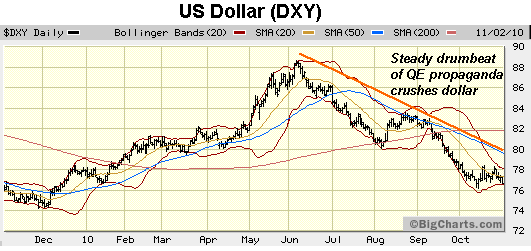
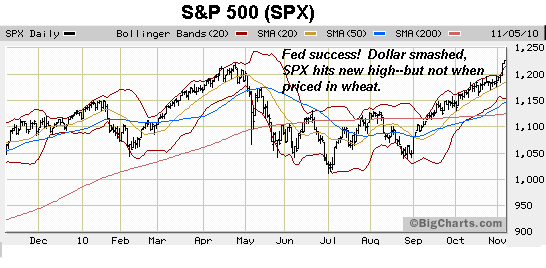
Stocks go UP, while the Dollar CRASHES!...And Gold, Silver, and most of the other Commodities go up, Up, UP!!!...Is this what Helicopter Ben intended with all of his Quantitative Easing?...Hyperinflation of food, gas, and other basic necessities?...This is a very interesting article that explains how the rise in equities is not such a good thing after all:
Stocks Have Collapsed in 2010--When Priced in Wheat
http://www.oftwominds.com/blognov10/stocks-quatloos11-10.html
Don't forget that Thursday is Veterans Day!...
Happy Trading next week!...
chartaholic
zigzagman
Tom

Sunday, October 31, 2010
End of the Week - S&P 500's Daily & Weekly Charts:
http://stockmarketchartanalyst.blogspot.com/
This will be one of the most interesting weeks this Quarter! By the opening bell on Wednesday, we will know the outcome of the mid-term election for the US House and Senate. It will be interesting to know the new balance of power there, but the market may or may not react much because it has already baked that outcome in. It's clear that the Democrats will lose a number of seats in both houses of Congress. The most important task for them to complete before the end of the year will be to decide if the Bush Tax Cuts will be continued, eliminated, or some kind of compromise is made to extend some (or all) of them.
Also on Wednesday at 2:15pm ET, we will hear what the Fed is going to do in the way of Quantitative Easing - Part 2 (QE2). The amount of QE2 they decide upon will be critical to how the market reacts to it. Not enough, say under $500 Billion, and the market probably will react in a negative way. Too much, say over $1 Trillion, and the market may not like that either. Anywhere between $500 Billion to $750 Billion is what the market is hoping for. And to hear the details of how the Fed will go about it will also get some kind of reaction from the market.
We are still in the middle of third quarter Earnings Reporting season, and it is also a very busy week on the Economic Calendar. So how the market moves this week will be decided by the outcome of the mid-term election, what the Fed decides to do with QE2, and the reaction to all of the week's Earnings and Economic Reports.
The Daily Chart shows a lot of Volatility last week, but by the end of the week the Index only closed up by 0.18 Points, and only up 0.02% I've been mentioning the Bearish Divergences on the CCI, STO, and MACD Histogram for a few weeks now, and with diminishing Volume every day last week, and large downticks on these three indicators, it looks to me like the market is running out of steam. But...the market was in "wait and see" mode the entire week waiting to see the outcome of the mid-term election, and what the Fed will do about QE2 next Wednesday. Basically, the Index churned (or consolidated) in an uptrend all week, and that is quite often Bullish. A close above the closing price from the previous Monday (10/18/10) with a tall white candlestick with above average Volume would be a breakout into Blue Sky Territory, and would obviously be Bullish...So would be a close above the 200Day Moving Average on the Weekly Chart, that currently sits at 1194.20

The Weekly Chart appears to be running out of steam. Volume has diminished the past three weeks, and the CCI has downticked the past two weeks. It is still in very Overbought territory in the mid-90's, and the fast line of Stochastics is now below the slow line. And the MACD Histogram also downticked last week. The Doji candlestick that formed this week may very well be a reversal signal this time, since the intra-week high last Monday finally tagged the 200Day Moving Average early in the session, and then pulled back hard the rest of the day to form a Bearish Shooting Star candlestick on the Daily Chart (see the daily chart above). A close below the low of the week from last week would be confirmation that the Doji candlestick formed last week was indeed a reversal signal.

I see a possible Bearish Double-Top Chart Pattern developing on the Daily Chart:

IF there is to be a Pullback, the Fibonacci's 61.8% level on the Weekly Chart is 1136.88 but there are some minor levels of Support to break below before it can get down to there.

The Commitment Of Traders (COT) chart is showing Large & Institutional Traders have been moving to the Short Side for a while now. These kinds of traders are hardly ever wrong. It is the Small and Individual Traders that are usually behind the curve.

It is a very busy week for Earnings Reports and the Economic Calendar. There are too many S&P 500 companies reporting this week to name them all, but the most important Economic Reports due out this week are signified by gold and red stars. A gold star report has the potential to move the market a small amount, and a red star has the potential to move the market in a big way. One of the most important reports due out this week besides the FOMC Announcement on Wednesday at 2:15pm is the Employment Situation report for the month of October, which is due out on Friday an hour before the opening bell:
http://online.barrons.com/public/page/barrons_econoday.html

I posted a number of very interesting news articles last week. Too many to list all of them here. They are posted on my Twitter account. Many of these articles discuss how effective will QE2 be, plus there are a number of articles about the economy in general and more about the Foreclosure-Gate fiasco.
My Twitter Page:
http://twitter.com/chartaholic
Happy Trading! next week...
It should be an exciting one!...
Stay Nimble...It could go either way...
zigzagman/chartaholic
Friday, October 22, 2010
End of the Week S&P 500's Daily & Weekly Charts + News:
http://stockmarketchartanalyst.blogspot.com/
Here is Technical Analysis of the daily and weekly charts for the S&P 500, plus a number of interesting news articles I read throughout the week...
The daily chart is Bullish for the most part with a positive Parabolic SAR and closing very close to Monday's close today...But there are still those nagging Bearish Divergences in the CCI and the MACD Histogram...The most notable thing happening on this chart is the Golden Cross...That's when the 50day Moving Average crosses up through the 200day MA, and is considered Very Bullish...But I think this kind of indicator is overrated because it is such a lagging indicator...It is considered a Buy Signal by some traders, but I use the CCI for my Buy Signal, which happened in early July and late August when it crossed up through the -100 line...The other thing to notice is that Volume diminished every day this week, but it appears that Volume isn't such an important indicator like it used to be, since the market has had a number of rallies on low Volume this year...Volume used to be THE most important indicator of them all...

The Money Indicators (Chaikin Money Flow, On Balance Volume, and Accumulation/Distribution) are all looking very Bullish, but CMF is lagging a bit because Volume was declining this week...

The weekly chart is still looking Very Bullish, but I'm expecting a ton of resistance at the 200day Moving Average at 1195.38...The CCI downticked on an up week, which is not ideal...And Stochastics remain very overbought, but most people don't realize how long it can remain so...Look at the previous two times it got above the 80 line...It stayed there for weeks on end, so I don't put much importance on STO except for when it gives a clear Sell Signal, which it hasn't yet...The MACD is Super Bullish...The only thing I don't like is the angle of ascent since the bottom in late August...It's waaayyyyyyy too steep, just like it was from early February until late April, and I still foresee a HUGE dump just like the last one IF the right catalyst comes along...Could that be bad blood after the G20 meeting this weekend that starts a currency war?...Or maybe the foreclosure-gate fiasco could really take off and hurt the big banks and mortgage brokers badly...There are a number of articles about this subject below the charts in the news section...

The Money Indicators on the weekly chart are SCREAMING Bullish...

-----------------------------------------------------------
Here are the most interesting news articles I read this week...The first one HAS TO BE the most important one of all...I don't trade Commodities at all and never have, because I heard a long time ago how Gold and Silver have been manipulated so much, and this article PROVES it...Truly and amazing read, in my opinion...It just shows us how extremely crooked the markets have become:
-----------------------------------------------------------
MASSIVE CORRUPTION!: Retiring CFTC Judge: We Covered Up Market Manipulation
NEW DEVELOPMENTS IN THE CFTC SCANDAL: On September 17, 2010, CFTC Administrative Law Judge, George H Painter, issued a "Notice and Order" announcing his retirement from his position. In this notice Judge Painter wrote of a conspiracy at the highest levels of the CFTC (within the ENFORCEMENT DIVISION) where a long time judge of 20 years has been conspiring with past CFTC Chairs to RIG THE ENFORCEMENT OF THE LAW by NOT finding ANYONE guilty of market manipulation. Here are Judge Painter's own words:
http://www.thedailybell.com/1461/Retiring-CFTC-Judge-We-Covered-Up-Market-Manipulation.html
-----------------------------------------------------------
MORE CORRUPTION: Congressional Staffers Gain From Trading in Stocks
At least 72 aides on both sides of the aisle traded shares of companies that their bosses help oversee, according to a Wall Street Journal analysis of more than 3,000 disclosure forms covering trading activity by Capitol Hill staffers for 2008 and 2009.
http://online.wsj.com/article/SB1000142
-----------------------------------------------------------
MORTGAGE-GATE: Mortgages Were Fraudulently Pledged to Multiple Buyers at the Same Time
Bank of America alleged in a court filing this June:
It appears as though many loans and other mortgage-related assets have been double and even triple-pledged to various constituencies.
http://www.washingtonsblog.com/2010/10/mortgages-which-can-legally-only-be.html
-----------------------------------------------------------
Homeowners’ Rebellion: Could 62 Million Homes Be Foreclosure-Proof?
Over 62 million mortgages are now held in the name of MERS, an electronic recording system devised by and for the convenience of the mortgage industry. A California bankruptcy court, following landmark cases in other jurisdictions, recently held that this electronic shortcut makes it impossible for banks to establish their ownership of property titles — and therefore to foreclose on mortgaged properties. The logical result could be 62 million homes that are foreclosure-proof.
http://seekingalpha.com/article/221344-homeowners-rebellion-could-62-million-homes-be-foreclosure-proof?source=yahoo
-----------------------------------------------------------
NY Fed, BlackRock and PIMCO Pressure Bank of America to Buy Back $47 Billion
Pacific Investment Management Co., BlackRock Inc. and the Federal Reserve Bank of New York are seeking to force Bank of America Corp. to repurchase soured mortgages packaged into $47 billion of bonds by its Countrywide Financial Corp. unit, people familiar with the matter said.
http://jessescrossroadscafe.blogspot.com/2010/10/ny-fed-blackrock-and-pimco-pressure.html
-----------------------------------------------------------
Mortgage Crisis Set to Kick Into a Higher Gear
Specifically, the question is how many mortgages were overpromised and overpledged -- sometimes two, three maybe five times, maybe umpteen times -- to back securities? How many fraudulent mortgage-backed securities now sit on Fannie and Freddie’s books? At the New York Fed? Who will be on the hook for those securities?
http://www.foxbusiness.com/markets/2010/10/19/mortgage-crisis-set-kick-higher-gear/
-----------------------------------------------------------
How the Foreclosure Fiasco Threatens the Economy
It might seem like a respite for struggling homeowners, but the sudden snags and slowdowns in thousands of foreclosure proceedings could prolong the housing bust well beyond its fifth year--and spell deep trouble for the broader economy.
http://finance.yahoo.com/news/How-the-Foreclosure-Fiasco-usnews-610419413.html?x=0
-----------------------------------------------------------
If This Is True...... KaBOOM!
If this is true it's not just systemic, it's not just common, it was the premise and basis of the entire securitization game - and "game" is the correct word for it, as the allegation made here is that the entire thing was a gigantic scam.
http://market-ticker.org/post=169779
-----------------------------------------------------------
NY to hold lawyers accountable on foreclosures
The chief judge of New York's courts on Wednesday imposed a new rule requiring lawyers handling foreclosures to verify that all paperwork is accurate.
http://finance.yahoo.com/news/NY-to-hold-lawyers-apf-671089494.html?x=0
-----------------------------------------------------------
SO IT BEGINS -- Bank of America Accused of Racketeering in Class Action Foreclosure Lawsuit
This is not going to end well for the banks. The trial lawyers have been unleashed. Best new job in America -- foreclosure class-action attorney.
http://dailybail.com/home/so-it-begins-bank-of-america-accused-of-racketeering-in-clas.html
-----------------------------------------------------------
Weakness In Bank of America Is Telling You Something
Stocks don’t lie, people do, reminds Guy Adami and I think weakness in BofA is trying to tell you something. It makes me wonder if the S&P is a little frothy. I don’t believe we can have a sustained meaningful rally in the S&P as long as the banks continue to underperform.
http://www.cnbc.com/id/39779193
-----------------------------------------------------------
Tab for Fannie, Freddie could soar to $363B
The government spelled out Thursday just how much the most expensive rescue of the financial crisis will end up costing taxpayers — as much as $259 billion for mortgage buyers Fannie Mae and Freddie Mac.
http://www.msnbc.msn.com/id/39776628/ns/business-us_business/
-----------------------------------------------------------
The Big Wall Street Banks Have Found A New Way To Strangle The American People: Predatory Property Tax Collection
It turns out that the big Wall Street banks have found a dirty new way to make loads of cash from U.S. homeowners, and they really, really don't want to talk about it. So what is this dirty new business? America's biggest financial institutions have become property tax collectors, and it is extremely lucrative. From coast to coast, the big Wall Street banks are buying up thousands upon thousands of tax liens and are making a killing by socking distressed homeowners with predatory interest, outrageous penalties and almost unbelievable legal fees.
http://theeconomiccollapseblog.com/archives/the-big-wall-street-banks-have-found-a-new-way-to-strangle-the-american-people-predatory-property-tax-collection
-----------------------------------------------------------
Foreclose on the Foreclosure Fraudsters, Part 1: Put Bank of America in Receivership
After a quick review of its procedures, Bank of America this week announced that it will resume its foreclosures in 23 lucky states next Monday. While the evidence is overwhelming that the entire foreclosure process is riddled with fraud.
http://www.huffingtonpost.com/william-k-black/foreclose-on-the-foreclos_b_772434.html?ref=fb&src=sp#sb=832484,b=facebook
-----------------------------------------------------------
Now We're Talking: BREAK 'EM ALL UP!
If the government does not hold the fraudulent CEOs responsible, who is supposed to stop the epidemic of elite financial fraud? The Obama administration's answer is the fraudulent CEOs themselves. You can't make this stuff up.
http://www.huffingtonpost.com/william-k-black/foreclosure
-----------------------------------------------------------
An Early Stress Test For The Financial Stability Oversight Council
How much damage to the financial system should we expect from what is now commonly called the foreclosure morass, the still-developing scandal involving document robo-signing (and robo-dockets), completely messed up mortgage paperwork and high-profile inquiries into accusations of systematic and deliberate misbehavior by banks?
http://baselinescenario.com/2010/10/21/an-early-stress-test-for-the-financial-stability-oversight-council/
-----------------------------------------------------------
Nasdaq %Above 50-day SMA reaches overbought levels $NAA50R - Don't Ignore This Chart!
The Nasdaq %Above 50-day SMA ($NAA50R) is trading near the prior 2010 highs. This indicator surged to the mid 70s in January and again in April. Prior moves to this area signaled overbought conditions that led to a pullback.
http://blogs.stockcharts.com/dont_ignore_this_chart/2010/10/nasdaq-above-50-day-sma-reaches-overbought-levels-naa50r.html
-----------------------------------------------------------
The Stock Market's Long Decline Has Begun
The Fed's campaign to boost the risk-trade in equities by destroying the dollar has reached its limits. Now gravity will take hold as stocks enter a Long Decline.
http://www.oftwominds.com/blogoct10/long-decline10-10.html
-----------------------------------------------------------
Three Words: NO ECONOMIC STANDING
If a loan is assigned to different tranches and/or different trusts, with each tranche or trust having its own series of credit enhancements and insurances, this means the possibility of multiple levels of insurance for the same loan, which goes to prove what we have been arguing for years: that upon securitization, the mortgage loans were insured with multiple layers of insurance so that when the loan went into default, those in the placement chain could reap untold profits by having the same risk paid over and over and over again through multiple claims or reserves. Anyone who read through the SEC v. Goldman Sachs lawsuit knows this.
http://market-ticker.org/post=169722
-----------------------------------------------------------
Inside the Illusory Empire of the Banking Commodity Game
Banking and fraud were born into our global word as Siamese brothers, inseparable since birth. And just like Siamese brothers, if ever separated, they would likely die together as well.
http://www.theundergroundinvestor.com/2010/10/inside-the-illusory-empire-of-the-banking-commodity-con-game/
-----------------------------------------------------------
PIMCO-Viewpoints: The Fed Feels Compelled to Experiment
This week’s release of the minutes of the September 21 meeting of the Federal Open Market Committee (FOMC) points to an activist Federal Reserve that is in policy experimentation mode – an institution that feels compelled to take additional measures to energize the American economy yet is uncertain ...
http://www.pimco.com/Pages/TheFedFeelsCompelledtoExperiment.aspx
-----------------------------------------------------------
David Malpass Gets Most Of It: The Fed's An Ass
Congress will face a runaway train on taxes and spending when it reconvenes after the elections. The solution is to restrain both—especially to stop the $6 trillion tax increase scheduled to take place on Jan. 1—in order to restore business confidence and help job growth.
http://market-ticker.org/akcs-www?post=169640
-----------------------------------------------------------
A "Watershed Event" for Bernanke: The Fed Is "Pushing Water with a Fork
When he declared "inflation is running at rates that are too low" last week, Federal Reserve chairman Ben Bernanke did a lot more than just pave the way for more quantitative easing, says Todd Harrison, CEO of Minyanville.com. The Fed chairman's use of the "d-word" (deflation) is "an admission of defeat" by the central banker, Harrison says. "It's a watershed event."
http://finance.yahoo.com/tech-ticker/article/535517/A-%22Watershed-Event%22-for-Bernanke:-The-Fed-Is-%22Pushing-Water-with-a-Fork,%22-Harrison-Says
-----------------------------------------------------------
Hussman Funds - Weekly Market Comment: The Recklessness of Quantitative Easing
With continuing weakness in the U.S. job market, Ben Bernanke confirmed last week what investors have been pricing into the markets for months - the Federal Reserve will launch a new program of "quantitative easing" (QE), probably as early as November. Analysts expect that the Fed could purchase $1 trillion or more of U.S. Treasury securities, flooding the financial system with additional bank reserves.
http://www.hussman.net/wmc/wmc101018.htm
-----------------------------------------------------------
End The FED. Get The Gold.
How can we end the Federal Reserve System? Prior to 2008, this question would have been entirely hypothetical. It is still entirely hypothetical, because the Federal Reserve System is in charge of monetary policy; the Congress of the United States is not.
http://news.goldseek.com/LewRockwell/1287324000.php
-----------------------------------------------------------
CBO Releases Official Numbers On Obama's Spending Record: In Two Years, An Increase of 21%
Perhaps you missed it, but then so did the Washington press corps. Late last week the Congressional Budget Office released its preliminary budget tallies for fiscal year 2010, and the news is that the U.S. government had another fabulous year—in spending your money. We didn't expect President Obama to hold a press conference, but why are Republicans so quiet?
http://dailybail.com/home/cbo-releases-official-numbers-on-obamas-spending-record-in-t.html
-----------------------------------------------------------
Tax Cuts Won't Cut It - by Peter Schiff
Congressional Republicans and Democrats are engaged in a heated debate over which Americans deserve not to have their taxes raised, with both claiming that some form of tax cut will stimulate the economy. The primary point of divergence is what type of cuts will be most likely to get Americans spending, and whether the wealthy will wastefully save their extra cash or use it to create jobs. This debate is academic. If a stronger economy (rather than pre-election posturing) is really the goal, then tax cuts alone will fail.
http://news.goldseek.com/EuroCapital/1287429142.php
-----------------------------------------------------------
The Financial Tsnuami Second Wave is on the Way
The spectacular, unrelenting rise of gold, silver and other commodities are signs that those who understand the unfolding financial calamity are taking defensive measures to protect the purchasing power of their wealth. Gold and silver have been the unanimous choice through history as the most basic forms of money in any kind of advanced society. The metals market is not being driven by little retail investors, but by Big Money heading for the exits from the FiatMoney Casino.
http://freeoklahoma.blogspot.com/2010/10/financial-tsnuami-second-wave-is-on-way.html
-----------------------------------------------------------
45.5 TRILLION DOLLAR LOSS
This is not just $45.5 Trillion in fraudulent assets (mostly Teir 1 assets for banks) but tacking on all the derivatives we end up with a number in the QUADRILLIONS!
http://www.roadtoroota.com/public/410.cfm
-----------------------------------------------------------
THE SUBPRIME DEBACLE: ACT 2 | PRAGMATIC CAPITALISM
There’s trouble, my friends, and it is does indeed involve pool(s), but not in the pool hall. The real monster is hidden in those pools of subprime debt that have not gone away. When I first began writing and speaking about the coming subprime disaster, it was in late 2007 and early 2008. The subject was being dismissed in most polite circles. “The subprime problem,” testified Ben Bernanke, “will be contained.”
http://pragcap.com/subprime-debacle-act-2
-----------------------------------------------------------
And my favorite story from last week still holds true...IMHO
Has The Fed Come To Their Senses Yet?
We all know that this recent stock market rally that began on August 25th, 2010 has been manufactured by the Federal Reserve Bank and the prospect of QE2 (quantitative easing). Since that time the stock market has rallied higher by nearly 13 percent. However, the U.S. Dollar Index has declined by nearly 13.0 percent since its June 7th, 2010 high. This tell us that quantitative easing has already been going on. If the U.S. Dollar has lost 13 percent and the stock indexes have rallied 13.0 percent what have investors really gained as stocks are denominated in dollar terms? It has really been a zero sum game and many people are hopefully realizing that.
http://www.inthemoneystocks.com/n_rant_and_rave_blog_single.php?id=10192
-----------------------------------------------------------
One of these days...Sooner than later...This house of cards is going to FALL...
GOT GOLD?...
Have a great weekend everyone!...
zigzagman
Tom
-----------------------------------------------------------


 Posts
Posts

